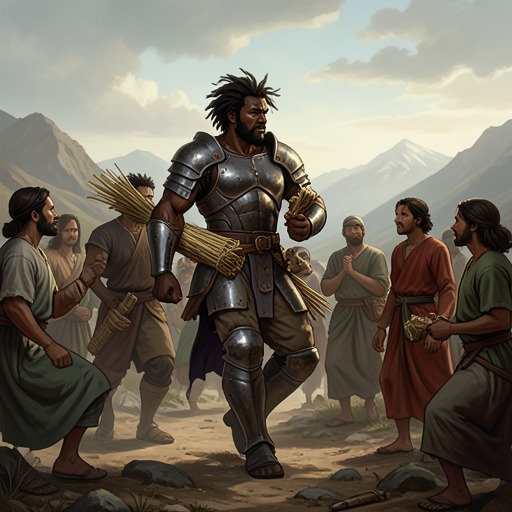
Lamanites
Book of MormonThe Lamanites are a principal people in the Book of Mormon, defined not simply by opposition to the Nephites but by a long, changing history of migration, inherited division, warfare, spiritual renewal, and covenant transformation. Their story begins in the family of Lehi, expands across wilderness and settled lands, and repeatedly overturns the assumption that ancestry fixes moral or religious identity.
Identity and Origins
The Lamanites originate in the family of Lehi, whose departure from Jerusalem begins a chain of migrations that eventually carries his descendants into the promised land. The record presents the Lamanites as a remnant of the house of Israel and places their history within the larger purposes of the Book of Mormon: to show what the Lord has done for the fathers of Israel, to affirm that the Lord has not cast them off forever, and to convince Jew and Gentile that Jesus Christ is the Eternal God manifested to all nations.
Their immediate political identity develops through the separation of Laman and Lemuel from Nephi and the rest of the family. After the Lord commands Lehi to take his family into the wilderness because his life is threatened, the family leaves Jerusalem under divine direction. The division is not an isolated quarrel but the beginning of distinct peoples whose relations will be shaped by memory, inheritance, land, and competing claims to authority.
The separation also has a demographic and relational dimension. Nephi and his brothers are later commanded to return to Jerusalem to bring Ishmael and his family into the wilderness. This journey expands the migrating community and establishes the family connections from which later generations arise. The Lamanites therefore emerge from a population formed through repeated movement rather than from a static settlement: Jerusalem, the wilderness, and the promised land remain linked in the people’s remembered origins.
Migration, Land, and Division
Migration continues to define Lamanite history after the first family division. Groups travel again into the wilderness in considerable numbers, and later movements include departure from settled lands, missionary travel across borders, and the relocation of entire communities. These journeys are not interchangeable. Some are commanded departures, some are movements caused by danger or political pressure, and some are undertaken as acts of faith or as efforts to preserve a people from violence.
The geography of the narrative makes the division concrete. The Lamanites and Nephites are described as separated by a line running from the east toward the west. This boundary is more than a map reference: it turns an inherited family dispute into an enduring territorial order. The Lamanites occupy both settled areas and wilderness spaces; the more idle portion of the people lives in the wilderness and dwells in tents, spreading through the land. The contrast between cities, lands of possession, wilderness camps, and borders shows how social identity is repeatedly produced through movement and settlement.
The record also connects the Lamanites with the people of Zarahemla through an older migration from Jerusalem. Mosiah discovers that the people of Zarahemla came out from Jerusalem when Zedekiah, king of Judah, was carried captive into Babylon. This discovery broadens the book’s account of Israelite dispersal and shows that the history of the land includes more than one migration from the Old World. Lamanite identity thus exists within a wider network of departures, scattered peoples, and preserved memories.
Conflict and the Possibility of Change
For much of the narrative, the Lamanites stand in conflict with the Nephites. The division of the peoples is associated with iniquity and separation from the presence of the Lord, and the record describes a severe curse imposed because of wrongdoing. Yet the narrative does not make that condition an unalterable essence. The Lamanites are presented as a people whose spiritual and political condition can change, sometimes dramatically.
The missionary work of Ammon and the other Sons of Mosiah marks one of the clearest reversals. When they arrive at the borders of the Lamanites, they separate and depart from one another, trusting in the Lord. Their movement across the border places them among a people long regarded as enemies, but the mission treats that boundary as a field for service rather than an absolute barrier. The missionaries’ work begins a process in which the Lamanites hear the word of God and respond to it.
The result is described collectively as the beginning of the Lord’s work among the Lamanites. They become a righteous people and establish a church among themselves. This transformation is significant precisely because it changes more than individual belief: it creates a religious community, redirects the people’s public identity, and demonstrates that the Lord’s Spirit is not restricted by former hostility or inherited political labels.
The movement toward peace also produces a practical migration. The people of the Lord gather their flocks and herds, leave the land, and travel into the wilderness. Their departure shows how spiritual allegiance and physical geography can become inseparable. A community may preserve its covenant commitments by abandoning possessions and familiar territory, turning migration into both a survival strategy and a public declaration of changed identity.
Relations with the Nephites and the Wider Story
The Lamanites’ relationship with the Nephites remains one of the book’s central structural tensions. They are divided by lineage, territory, and memory, yet they are also connected by common ancestry and by the possibility of shared covenant belonging. The narrative repeatedly places these two peoples in contrast so that their differences can be measured not only through war but through their responses to prophecy, repentance, teaching, and divine judgment.
Their story also intersects with the book’s recurring pattern of destruction and reconstruction. A voice is heard among all the inhabitants of the earth and across the land during a catastrophe, while later promises announce that the Lord will establish his people and that the fulness of the gospel will be preached to the house of Israel. These declarations place the Lamanites within a future-oriented history: they are not merely a hostile population in an earlier conflict but part of the house of Israel addressed by promises of establishment, gathering, and renewed divine relationship.
The Lamanites therefore function as a test of the book’s claims about history and identity. They preserve the consequences of family division, but they also expose the insufficiency of judging a people solely by an inherited label. Their repeated capacity for conversion, church formation, migration, and alliance makes them a counterweight to any simple Nephite-centered account of the land.
Narrative Significance
The Lamanites embody the Book of Mormon’s sustained movement between separation and reunion. They begin as descendants caught in a family rupture, become a people divided from the Nephites by geography and hostility, and later appear as recipients and agents of religious renewal. Their history joins the intimate scale of brotherly conflict to the broad scale of Israelite dispersion and gathering.
Their importance lies especially in the tension between inherited condition and chosen response. The record acknowledges curses, iniquity, war, and exclusion, but it also narrates the Lord’s work beginning among the Lamanites, a righteous people establishing a church, and migrating communities acting to protect their new commitments. Through them, the book presents identity as historically burdened but not morally closed: ancestry explains conflict, while faith and covenant make transformation possible.